

Organization
About Us
Learn about the Heartland Center for Jobs & Freedom, a Kansas City nonprofit advancing civil rights, fair housing, worker justice, and economic opportunity through legal services, support, and organizing education for workers and tenants.
Mission
The Heartland Center's mission is based on our belief in democracy, human rights, and the dignity of every person. Helping individuals navigate legal challenges is essential, but our work doesn't stop there. We pursue systemic change driven by the low-wage workers and tenants we represent, ensuring that future generations live in a more just society.
Vision
Our vision is that working people of all races and backgrounds will have the power and influence to ensure that everyone who works can live a full life free of abuse, exploitation, and poverty.
The history behind our name
We take our name from the 1963 March on Washington. The lesser-known full name of that historic event was the “March on Washington for Jobs and Freedom,” which ended with Dr. King's historic “I Have a Dream” speech.
When more than 200,000 Americans gathered that day, they called for an end to discrimination and segregation, and for full employment and living wages. Heartland carries forward the legacy of those who believed that racial equality, good jobs, and good homes for all were not only imperative, but inextricably bound and critical to the welfare of our entire nation.
Ella Baker, a brilliant strategist, organizer, and leader, helped build the civil rights organizations that drove the movement. She believed, as we do, that social change can only come about when masses of ordinary people come together, unite, and organize. We look to her example as we provide training to the low-wage workers leading movements for change.
For our legal work, we draw inspiration from civil rights pioneer Charles Hamilton Houston — fondly called “the man who killed Jim Crow” — who crafted the legal strategy that led to Brown v. Board of Education. Like him, we believe the highest calling of an attorney is to work toward the transformation of society.
We also look to Frances Perkins, the Secretary of Labor who, as workers organized from the outside, crafted the legislation that gave us the minimum wage, the eight-hour day, and Social Security.
A timeline of the movement we come from
- 1935
Frances Perkins & the New Deal
As Secretary of Labor, Frances Perkins crafted the legislation that gave us the minimum wage, the eight-hour day, and Social Security.
- 1954
Brown v. Board of Education
Charles Hamilton Houston's legal strategy dismantled “separate but equal,” proving the law can be a tool to transform society.
- 1960s
Ella Baker & grassroots organizing
Ella Baker built the civil rights organizations that showed change comes when ordinary people unite and organize.
- 1963
March on Washington for Jobs and Freedom
Tens of thousands called for an end to discrimination and for full employment and living wages — the march we take our name from.
What we do
We defend the legal rights of workers and tenants, help them grow their collective power, and work to build a racially and economically just society.
Organizational history
- 2011
Expanding access to free legal services
Stand Up KC, a grassroots organization fighting for better conditions for fast-food, retail, and low-wage workers, partners with local attorney Gina Chiala to expand access to free legal services.
- 2013
Standing with workers against sexual harassment
Stand Up KC supports the landmark McDonald's “Me Too” lawsuits, standing alongside workers who filed legal complaints over systemic sexual harassment. Gina Chiala provides pro bono legal services to testifying McDonald's workers.

- 2016
Heartland Center is founded
Building on the momentum of Stand Up KC, Gina Chiala and six founding board members establish the Heartland Center for Jobs & Freedom with the belief that lawyers can only win real change when acting in concert with broader social movements.
- 2019
Tenant Bill of Rights and first class action
HCJF is instrumental in passing Kansas City's Tenant Bill of Rights, which strengthens protections against discrimination, illegal evictions, housing-code violations, and retaliation for tenant organizing. HCJF also launches its first class action against Del Properties over unlawful lease practices, security-deposit violations, and substandard living conditions.
- 2021
Responding to the housing crisis
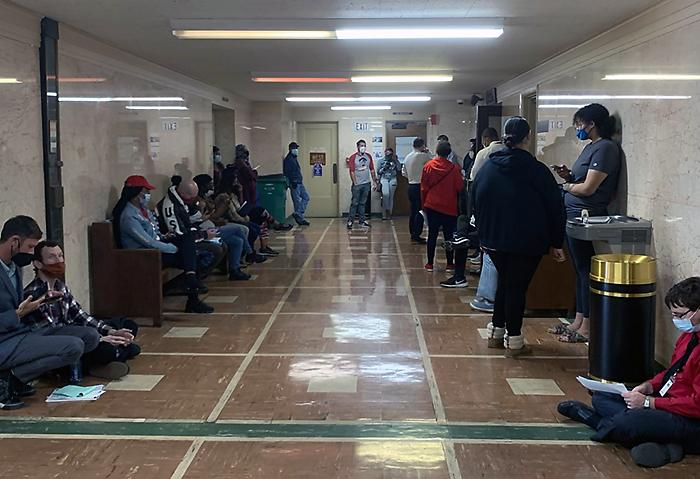
Heartland responds to the COVID-19 housing crisis by attending eviction court and notifying tenants of their rights in eviction proceedings.
- 2022
Kansas City adopts Right to Counsel
HCJF helps pass Kansas City's Right to Counsel ordinance, a pioneering law that guarantees full legal representation to tenants facing eviction, regardless of income. This work would later inspire Heartland's Eviction Defense Program.
- 2023
Worker Power Project launches
Heartland formally launches the Worker Power Project through funding from the Skadden Foundation, increasing HCJF's capacity to combat wage theft and unsafe workplaces through free legal representation and bilingual community education.

- 2024
Organizing and a landmark tenant settlement
HCJF plays a crucial role in defeating the Royals stadium tax at the ballot box. Heartland also obtains a landmark $1.85 million settlement in its first class action, securing relief and reforms across Del Properties' portfolio, including professional pest control, stronger security-deposit protections, fairer lease terms, and the elimination of unlawful fees and one-sided contract provisions.
- 2025
Stable Homes and regional expansion
Heartland creates the Stable Homes Program to preserve stable and affordable housing, prevent displacement, and enforce protections in affordable-housing programs such as the Low-Income Housing Tax Credit program. Heartland also expands its reach and services to Springfield, Missouri.
- 2026
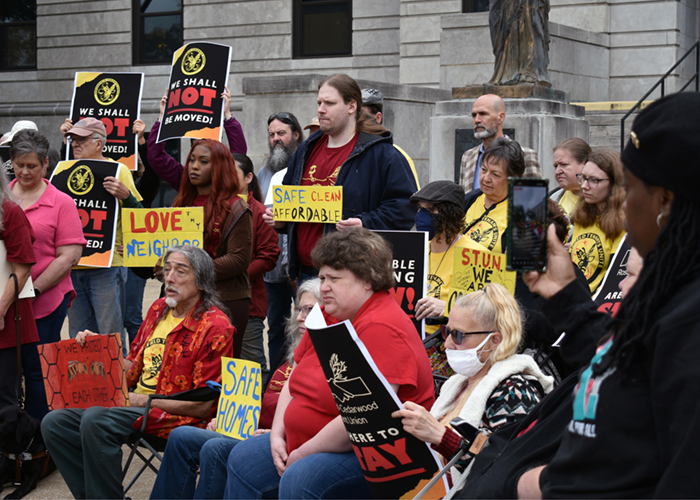
Rosewood-Cedarwood tenants win an injunction
Rosewood-Cedarwood tenants in Springfield, represented by HCJF and Springfield attorney Eric Jensen, win an emergency preliminary injunction halting plans to evict low-income, senior, and disabled tenants from their homes in August 2026.